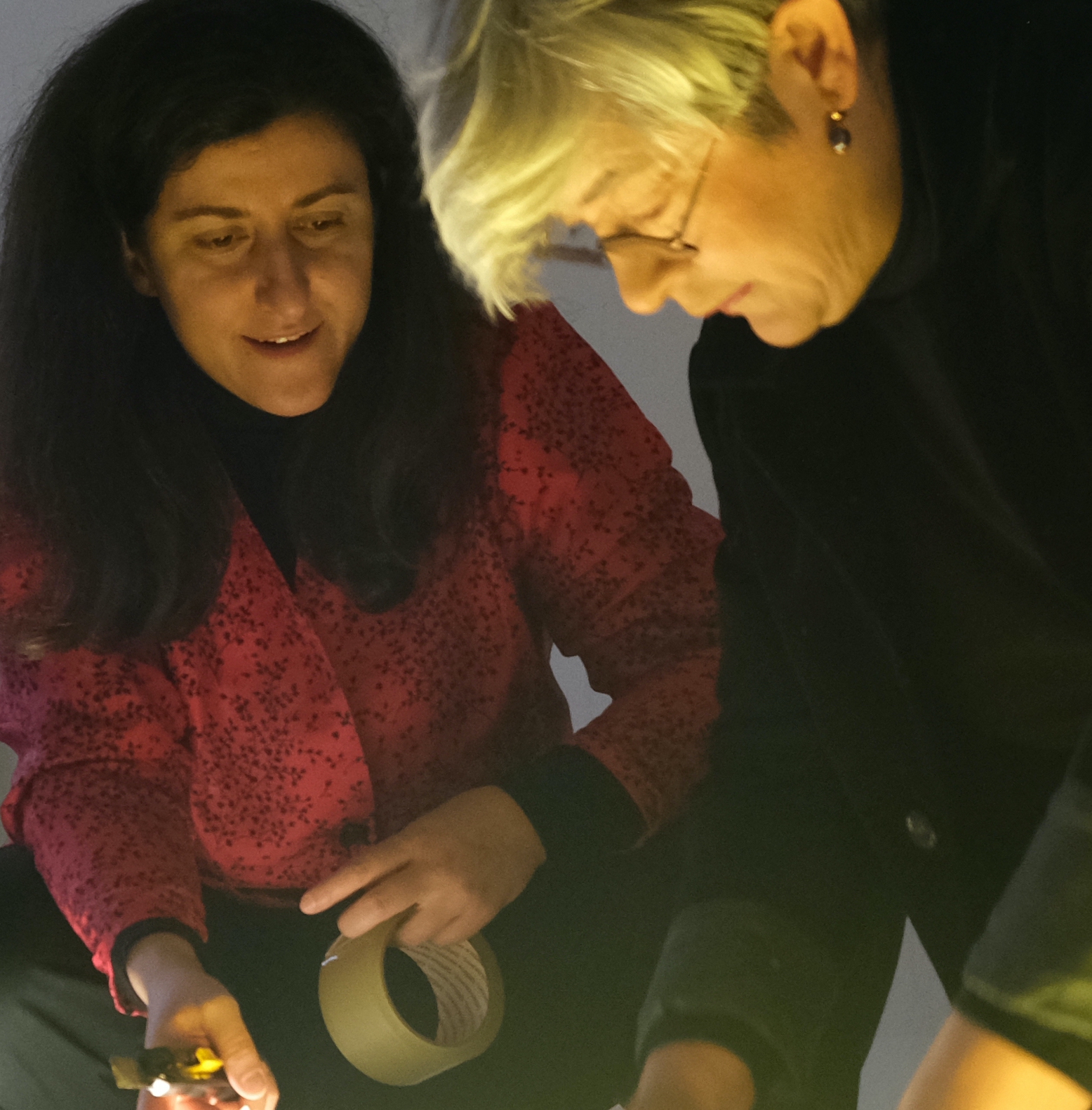
Curator Sona Stepanyan and artist Natasha Dahnberg
Pic and interview by Steuart Wright
From a childhood shaped by conflict, through the art scenes of Moscow and Armenia and onto new horizons in Sweden, the arc of independent Armenian-born Stockholm curator Sona Stepanyan’s practice is guided by personal history, lived experience and a positive orientation toward the future.
When we met, Sona was helping install a large work she had curated in a small space, Stockholm’s AllArtNow Lab, aptly titled Growing Pains featuring Russian-born and Uppsala-based Natasha Dahnberg’s personal look at displacement and abandond communal spaces which began during the pandemic but was consolidated by Russia’s invasion of Ukraine in 2022.
Natasha’s Moscow apartment had become a personally poignant abandoned space when her mother moved to join her in the safety of Sweden. Frozen in time, Christmas decorations still up exactly as they were the day the war started and her mother had to leave, her installation was a statement about belonging, memory and the unseen impacts of geopolitical conflicts that crash into the most intimate spaces, the forced choices and human costs of war on all sides.
The image of an empty home is a striking detail, the choice of AllArtNow was significant, the residential apartment blocks of Stockholm’s Hjorthagen in Ropsten suburb were reminiscent of the standardised modernist architecture and post-war industrial history of the Moscow suburb of Natasha’s youth and highlighted the emotional charge of simultaneous recognition and alienation of a universally relatable experience, bidding farewell to one’s home.
Natasha combined wild reeds with her ambiguous charcoal and pastel depictions of what appeared to be smoke or clouds. They served as a natural symbol for abandonment and drive home how traces of destruction and human absence succumb to new presences. Sona reflected how Natasha’s Moscow neighbour, Marina, who holds the keys to the apartment and sends mobile video recordings from inside as a kind gesture was like a reed which occupied a space that was not hers.
Natasha’s mother’s journey to Sweden is mirrored in Sona’s, only her exposure to war and displacement began as a child. Born in Kapan, Armenia, in 1987. Faced with the devastation of the family home and post-war struggles including scarcity and hunger, her family fled to Moscow when she was seven to escape the Nagorno-Karabakh conflict with neighbouring Azerbaijan. There, she dreamed of studying art and was encouraged by her father, an amateur painter, however, those dreams were put on hold by corruption in Moscow’s art school entrance exams.
“It was not just a matter of having motivation, skill and talent, it was also a matter of having enough money to pay for so-called ‘extra classes’ with the tutors who were the professors at the university. Practicing art during my school years had already been a privilege and a large expense for an immigrant family with four kids. I had to look at how I could support my family and not take more,” she explained.
Sona studied pedagogy instead, then worked as a teacher – while simultaneously moonlighting as a project manager – for several years and held close her dream of working with art. Although she had not heard of curating, an artist friend who knew she was tired of teaching handed her a brochure and suggested it could be interesting to her. Her first curating exam was a humbling experience.
“I still remember it, the A6 leaflet said this was the first curatorial school programme opened by the Museum of Modern Art in Moscow. So, I went to the exam and I failed,” she laughed. “I expected the exam to be about the classical art history I was used to seeing in museums and during free evening art classes like Renaissance art or Impressionism. Okay I knew Ilya Kabakov but I did not know much about contemporary art,” she explained.
Contemporary art wasn’t her background, she literally didn’t know who Marina Abramovich was. It was her sheer determination, her “arrogance, this absolute drive to be there”, that convinced the examiner to give her another chance and enrol her as an additional student in the six month curatorial course.
“Doing studio visits, meeting living artists and going to contemporary art museums, I was honestly like a kid; I was so amazed. It made me so happy. I realised I was good at the practical production side; I knew to become familiar with the theoretical side I had to educate myself,” she explained.
Her curatorial journey took off when Sona enrolled for a master’s programme in 2012, around the same time as what had been a slow emergence of contemporary art in former Soviet republics started to really take hold.
This ethos carried right into her next venture. After her master’s degree, Sona co-founded the Triangle Curatorial Studio in Moscow with a collective of about 14 self-employed curators.
“This was where we continued our self-education and experimented with curating. We shared a factory space, used a Google Calender to divide the year into 3 week-long exhibitions, worked other jobs due to the lack of funding for curators – especially outside of state institutions in Moscow – split costs, experimented with exhibitions in energetic collaboration.” They helped each other with everything from social media to building podiums for shows.
They fostered this community that supported diverse work without censorship representing a dynamic grassroots development which created space for experimentation outside traditional institutional systems. And it worked. It was incredibly successful. “Many star curators and guests were coming to us for informal talks,” she pointed out.
Triangle was a launchpad, many curators went on to secure positions in major institutions. For Sona it was the beginning of a journey home that started with a posting at Moscow’s prestigious Garage Museum.
“Here my pedagogical education helped a lot because I was working in the education department with curators building the public programme. After several years of getting deeper into theory and practices of contemporary art as well as doing my small independent shows, I realised I should go back to Armenia. So much of what I was reading about involved heavy stuff that happened to my family as well. I wanted to reflect on it, on Armenian art history and Armenian history: the Russian Empire and then Soviet expansion, independence and the Nagorno-Karabakh conflict of course,” she said.
Sona had developed a keen interest in decolonial theory and could no longer address her “burning memory of home” from a distance. She needed proximity and took a curatorial post at a private foundation in the Armenian capital, Yerevan. She learned local contemporary art history from the inside out which culminated in a compelling exhibition Power Nap in 2018.
She had embarked on a year of deep research. “My Yerevan apartment became a real curatorial studio and a space for artistic gatherings,” and a base for developing conversations with artists, cultural workers and reading and learning from out in the field.
“Power Nap provided the possibility to work long-term and deeply with context and artistic needs, to change exhibition statuses toward the art community’s concerns, not to attract the most visitors. I had no need to serve the public. I chose to build and exhibition for the artists, a place where they would want to come themselves,” Sona explained.
She recruited “once socially engaged” Armenian artists for a very political show, many of whom had withdrawn from the public sphere to seclusive studios in a “symbolic power nap”.
She said there had been a collective crisis in artistic and political activities in post-Soviet Armenia preceding the 2010s which was characterised by “opaque and chaotic artistic processes – an artistic and institutional solitude and fragmentation”.
However, Sona thought of the title encapsulating a period of consolidation, perhaps of preserving energy for a bigger movement, while simultaneously implying the political elite were napping, oblivious to brewing discontent – a theme reflected in the works of invited international artists.
In a powerful twist, the exhibition coincided with Armenia’s Velvet Revolution which brought new political leadership to power, Sona literally witnessed the artists she’d worked with return to the streets with newfound passion. It completely changed her understanding of her own relevance and the timely impact, insights and sensitivities curatorial work could have.
“You see the gap you can fill; you see the need you can serve, you see a possibility for change and that as a curator you have the means to make it happen for the artistic community,” she said of this formative experience now uniting her practical production with a maturing contemporary-art wisdom which encouraged institutions to take her into their confidence. Inspired and quick to challenge established narratives, she pressed on with a follow-up, a more poetic exhibition called The Sun of the Sleepless which pointedly asked: “What’s next after the revolution?”
Sona was generating and participating in necessary dialogues, profoundly demonstrating the power of a context-driven practice in response to urgent local needs and not just building a personal portfolio or cv. She noted that Armenia survived largely on the help of enthusiasts, diaspora support and what we call “soft power” structures, or influence through collaboration with Western cultural institutes rather than direct political intervention.
Her contract in Armenia ended in 2019. Sona decided to move to Sweden to join her partner. She was eager to explore new curatorial discourses, moving beyond constantly revisiting the painful past.
“I really needed to stop working with post soviet decoloniality because I was fed up with the past. It can be very supportive, but destructive at the same time when there are all these ways to constantly poke an open wound. I didn’t want to do it anymore. I needed tools to turn the discourse toward the future. What happens when you curate in a peace zone. I wanted to learn something new, something that would amaze me again,” she said.
Sona enrolled in another master’s program, this time at Stockholm University. The Swedish art scene was eye-opening for her. She was amazed how embedded art was in the public sphere and the Swedish commitment to public art, demonstrated by the 1% rule, where 1% of construction budgets were allocated for public art found in hospitals, schools, even the Stockholm subway system.
“It belongs to all the people. Compared to places I’m coming from; this is fantastic to me. The whole public art sector in Sweden. Wow!” she said.
In this seemingly peaceful, future oriented place, she started noticing things about the art world that made her think quite critically. She talked about what she called “the logic of a single project”. The Swedish system was heavily reliant on grants for projects with clear start and end dates and defined deliverables.
Organised, yes, but she saw a homogeneity in artists’ studio practices and scale of work which tended to align with the values and funding parameters of institutions.
She explained the cultural sector was based on “profound trust” between citizens, artists, institutions and the government – a stark contrast to previous experience where private funding was the norm and institutions were viewed with suspicion.
“I believe this can limit artistic freedom, especially if one day a right-wing government takes over,” she warned amid nationalist tendencies globally.
Feet planted firmly on new ground and oriented toward a future discourse around environment and post-humanist explorations of the blurred lines between humans, technology and nature, Sona as curator has demonstrated the positive effects inclusion of fresh perspectives can have on a sophisticated but fortified Stockholm cultural sector.
Sign up to our newsletter
For highlights from the latest issue, our archive and the blog, as well as news, events and exclusive promotions.