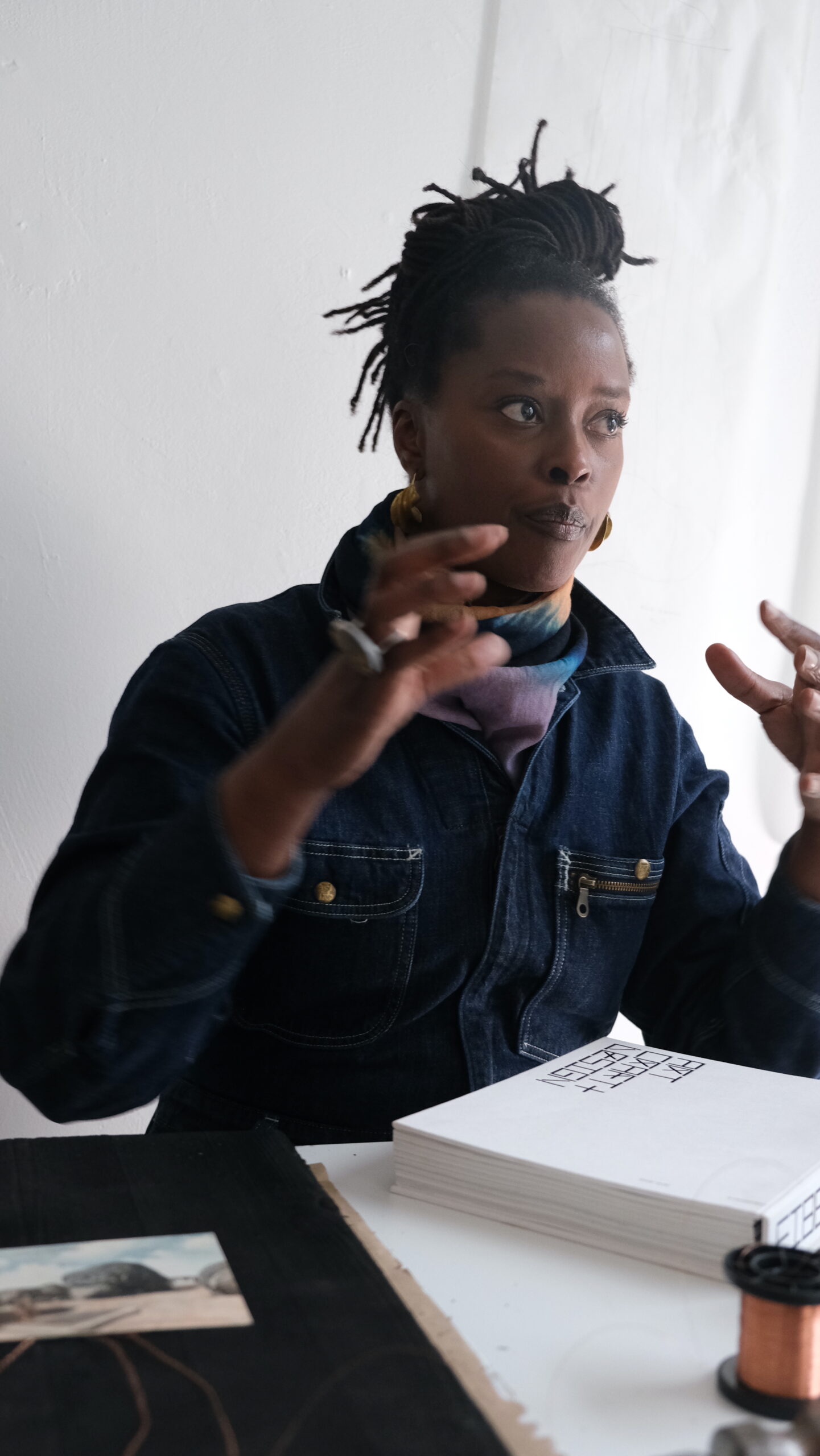
Marcia Harvey Isaksson embodies a cultural momentum around the “Afro-Nordic” experience that comes from consistency over rebellion. To say she has weaponised her creative energy against negative tropes and institutional resistance to cultural forces on the Stockholm fringe hints at a hostility that is not there.
A modest Stockholm art centre, Southnord is separated from the street by two storefront windows that belie the power and reach of founder Marcia’s multi-disciplinary approach to cultural production, a balance of opposites that unites her southern-African roots with her naturalised Nordic home through collaborations with colleagues from the region and African diaspora.
I enter the small front of house, just four walls around two tables pushed up against each other where Marcia is seated. She is weaving copper threads as we talk, at once filling the room and creating space for people who enter.
“I like multiplicity. I like doing different things every day,” says the Zimbabwean-South African Swede of 21 years who transitioned from accounting to a practice that blends her education in design, architecture and art in an emergent role as curator through collaborations with colleagues from the Nordic region and African diaspora.
Marcia is the driving force behind Southnord Artfest, a triennial of international artists that dominated Stockholm’s Kulturhuset in 2023, presenting streams of consciousness which sooth irritations with the conventional art scene, at times xenophobic with its narrow take on “shared cultural heritage”. Marcia is not defeatist; she is actively tearing down and rebuilding institutional frameworks, particularly in the Nordic cultural scene, with a strategy that blends deep southern-African history with a fiercely autonomous approach to production.
In 2015 she founded Fiberspace, her textile gallery which mines possibilities in “textile and fibres from high-tech smart textiles to traditional techniques and materials”, and this is where the friction really begins, a big difference in operational speed between the Swedish institutional pace and a quick-execution, Zimbabwean style.
Fiberspace is a model of pure autonomy, almost a guerrilla operation, self-funded, working nights and weekends from cleaning to hanging works because, for Marcia, the real value is freedom; total control. She did not use institutional funding at first. Her approach was validated later, when she applied for funding from the city, and it was forthcoming.
Sweden can feel institutionally overbearing, consensus-driven and conflict-averse, which brings a resistance to transformative ideas and practices. Overcoming it creates a momentum that I begin to understand in the output Marcia delivers in the community-focused Southnord.
“When I started researching this, there were a lot of separatist events, where it was like Bipoc only, Black, Indigenous, and People of Colour only. And I felt that was not constructive. I got a lot of pushback. Of course we need safe spaces. But at the same time, we are a part of the society and we are part of building the society, and our tax money is going to these institutions. I feel quite the opposite, actually, that we should take space in society. If they’re not working the way we want them to, then we should say, hey, you know what? You’re doing this wrong.
“I think it’s refreshing to come here with a different attitude because I’m very non-Swedish. I’m so Zimbabwean in a way. People in Zimbabwe are very hands-on. They get things done,” she says.
Bringing Artfest to life highlights the institutional rigidity she is up against. When trying to stage the event that needed the whole of Stockholm’s Kulturhuset.
Marcia was compelled her to draw up three different budget lines and seek agreement of four department heads to use the same wall for one projection. Arguing that it was an art fest and not an exhibition was a perpetual sticking point, which she found exhausting. Language itself becomes a constraint that lends itself to a homogenous experiences across platforms but Kulturhuset Head of Culture Linda Beijer “intervened to help the idea of an artfest take root”.
That distinction matters, an exhibition sounds static, maybe objects in a white box, whereas an art fest, especially the way she does it, implies performance, community, process, using the whole atmosphere – an immersive event which the segmented bureaucratic mind traveling down grooves of well-worn protocols struggles with.
“I was constantly pushing them to the edges of what they think is possible. In my space, if I decide I want to have a crowd weaving. I’m going to bring a loom, build it up, and we’re done in two days. They are like: ‘Oh, no, we have to have a meeting and we have to get together and we have to think about it. Maybe in two months we could make it’. So frustrating. So I think that’s also part of what someone needs to do is come in and disrupt and challenge,” Marcia explains.
Southnord was born out of her need to straddle two worlds. Always drawn south but embedded in the north – where her sons were at school – and feeling that resistance, that friction, that need to push against stagnation, it is not just about art, it comes from somewhere personal.
The catalyst was exhaustion. “I was so sick and tired of the narrative in this space. If you turn on Swedish radio, Swedish news, Swedish TV, everything about Black people in Sweden is just negative. Also, my kids have just become adults. My oldest son gets profiled by the police a lot, they stop him randomly: ‘Show us your ID, and what are you doing here at this time of night?’ He works at a restaurant. He’s been working at restaurants since he was 15. At least he can speak for himself, but his younger brother is super introverted and shy; that (experience) would damage him forever. He would never want to see a policeman again.”
Southnord is a deliberate platform using existing infrastructural resources to show a totally different picture, a positive one, and while there have been many projects, exhibitions and interventions along the way, it has culminated in Artfest, which will roll on in Finland in 2026 and Norway in 2029.
The idea was for a big manifestation with 20 artists of African diasporic and northern origin, Ernest Mancoba, Michelle Eistrup, Sasha Huber and Santiago Mostyn among them, but it grew to include over 100 contributors with film screenings, talks, workshops and crucial collaborations with groups like Black Archives Sweden – that demonstrates the hole in archival processes when it comes to understanding shared cultural heritage – and ASSATA Activist Library – Norway-based printing press and library focusing on decolonisation and revolutionary knowledge.
What strikes me is the curatorial approach. She is very clear it is not about being a victim or a minority. It is about showcasing artists who use their voice to try to make sense of the world. She combines established names alongside artists who have maybe been forgotten, and new voices all in the same space, giving them equal weight and creating an anti-erasure archive.
“We documented all of that. One part of Southnord that’s super important is building up an archive of interviews, of photographs of all kinds of material that the next generation can come back and not be like: ‘Oh, there were no Black people making art in the 2020s’, because nobody bothered to document it. That’s a problem when you look at who was making art in the 1980s, who was in the museum collections, who was of African descent? You can’t find that information. So in a way, we’re also having to go back and ask, can we fill in a few of the holes?” Marcia explains.
COMMUNITY
Artfest was a hit that won the attention of the mainstream media, but that is not the measure of Marcia’s success. “The media have this amplifying voice to get into people’s consciousness, they have that power but I’m like, come if you want. I am not doing this for you. The focus really is, can we do something that is super high quality, where artists come, have time for conversations with colleagues and feel very proud to be part of it. I think at the back of my mind I was asking if my sons come to this, if other Black kids come to the space, or brown kids, or whoever, will they recognize themselves?” she says.
Clearly, it resonated because the feeling afterward was that this couldn’t just be a one-off; everyone involved felt they had created something that needed to continue. The idea is to systematically infiltrate and reprogramme the cultural infrastructure region-wide over time and build something lasting.
Marcia’s professional background, her methodology, and her intense focus on execution doesn’t come from a standard art history track. She studied at Beckmans College of Design in Stockholm, which led to architecture and exhibition design for museums. That is key to understanding Marcia’s orientation, she starts not from the art object but from the perspective of the visitor.
“I’m telling a story through objects, room space, lighting, ambiance, music, smell, touch, the feeling and the text, of course. How do you help people along? Museums want to impart knowledge and they want to tell you something. It’s not really the same as curating art. When I started understanding that and I got this space, I began to experiment with telling stories in my own way. I think the most successful projects that were here were the ones made specifically for this space,” she explains.
Designer, spatial storyteller, cultural producer and artist are important designations for Marcia because they reflect where the energy and resources go. Her personal art practice seems to be a reaction to the intensity of producing, a literal return to craft weaving. Marcia calls it a necessary outlet, physical therapy. “It is so universal. A weaver from India or a weaver from Mexico, or a weaver from South Africa, or a weaver from wherever, they have this common language, they don’t even need spoken words.”
The copper piece she is working on takes that universal technique and grounds it very specifically in a universal geological history, on rocks, stones, extraction and mineral wealth woven into the fabric of humankind – collapsing personal history, trauma and global economics – that will link the red earth of her Zimbabwe home to copper and steel mines in Sweden where she will exhibit.
I say goodbye to Marcia the artist, and emerge into the busy wintery street emboldened by her personal triumphs armed with discipline and humanity. I glance through the window’s reflections, Marcia appears still, the copper threads flowing like light on water before her.
Sign up to our newsletter
For highlights from the latest issue, our archive and the blog, as well as news, events and exclusive promotions.